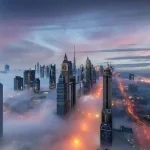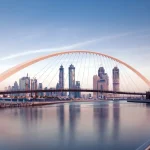
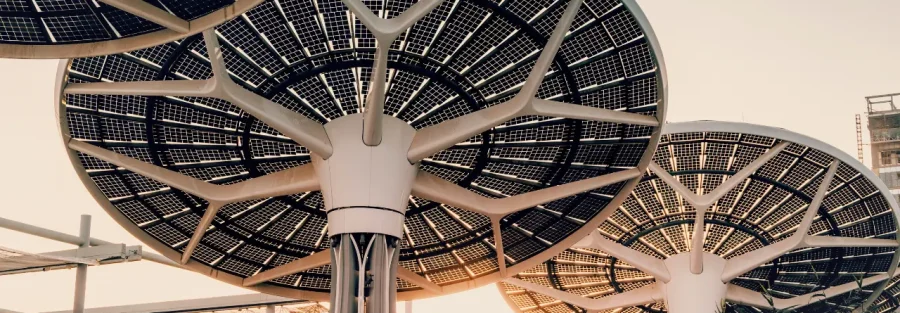
Most cities build in one direction at a time. Up, when land runs out. Outward, when the population grows. Occasionally inward, when a government decides to renovate something. Dubai is currently building in six directions simultaneously and has not announced when it plans to stop. The forest is going into the sand. The taxis are going into the sky. The tunnels are going under the mall. The tower is going past every record on the books. The rain is going indoors. And the airport is going well beyond any number the city has hit before. July 2026. A routine construction update.
Growing Into the Sand
Ghaf Woods broke ground this year on Sheikh Mohamed bin Zayed Highway. It will be a residential community of 738,000 square metres planted with 35,000 Ghaf trees. The Ghaf is the UAE’s national tree. It has survived in desert conditions for thousands of years on minimal water and no irrigation plan. The development expects the trees to lower ambient temperatures by up to 5 degrees and improve air quality by 20 percent. The city it is growing inside receives 100mm of rain a year. People will live in the forest. The forest will have a mall.
Flying Into the Sky
Sheikh Zayed Road moves slowly. Rather than widen it, Dubai added a lane above it. In partnership with Joby Aviation, the Roads and Transport Authority began testing electric air taxis this year. Four passengers, one pilot, 320 kilometres per hour, zero local emissions. A trip from Dubai International to Palm Jumeirah takes minutes. Vertiports are going up at the airport, Downtown, Marina, and the Palm. Dubai already sends aircraft into clouds every morning to negotiate rainfall. The sky above the city has been in active use for some time.
Dubai is digging down and building up at the same time and has not scheduled a meeting to discuss whether this is a lot.
Boring Under the City
The Boring Company began construction on the Dubai Loop in early 2026. The pilot link runs 6.4 kilometres between Dubai Mall and Business Bay. The full network will cover 22.2 kilometres with 19 stations, electric vehicles moving through dedicated tunnels at highway speed. The budget is 2.5 billion dirhams. The tunnels run directly beneath a city that is simultaneously erecting a tower above 900 metres. At ground level, Sheikh Zayed Road continues at its own pace, entirely unaware that the city has simply added two more floors.
Rising Past the Record
The Dubai Creek Tower tender was issued in January 2026. Santiago Calatrava designed it around lily petals, mosque minarets, and traditional dhow sails. Ten observation decks shaped like lily buds sit near the top. Over 10,000 LED lights run the exterior. The confirmed height is above 900 metres. The Burj Khalifa stands at 828 metres and is currently the tallest structure on earth. Dubai built that one too. The exact height of the new tower has not been released.
The Numbers
The Eiffel Tower is 330 metres. The Empire State Building is 443 metres. The Burj Khalifa is 828 metres and holds the current record. The Creek Tower will be taller than all of them. By how much, Dubai has not said. The fact that it has not said suggests the number is worth waiting for.
By the numbers ·
35,000 trees growing in a desert city. 22.2 kilometres of tunnels under construction. 900 plus metres rising above the creek. 260 million annual passengers planned for the new airport. 320 km/h in the air taxis. 100mm of rain a year, naturally. One boulevard where it rains indoors. Zero of these are described by Dubai as out of the ordinary.
Raining Against the Climate
On the Heart of Europe development, on artificial islands arranged in the shape of a map of the world off the Dubai coast, there is a hotel with a covered boulevard where rain falls from the ceiling. Engineers fitted concealed fountains into the rafters. When outdoor temperatures exceed 27 degrees, which between June and September they do every single day, it drizzles indoors. The UAE receives 100mm of rainfall annually. One kilometre of European boutiques receives additional precipitation by thermostat, on demand, year round.
Building Ahead of the Population
Al Maktoum International is being expanded to handle 260 million passengers a year. Five terminals, five runways, 70 square kilometres. Dubai International, currently one of the busiest airports on earth, handles 92 million. Phase one targets 150 million by 2032. Dubai has been asked before who will fill its largest projects. The answer has historically been: people who were not here yet when the question was asked. The airports, the towers, the malls, the palm islands. All of them were built ahead of the crowd. The crowd arrived.
Six directions, all active, all on schedule, all in the same city, in the same year. The forest is in the sand. The taxis are in the sky. The tunnels are under the mall. The tower is past the record, height pending. The rain is indoors. And the airport is ready for a number Dubai has not hit yet but has, characteristically, already built for.