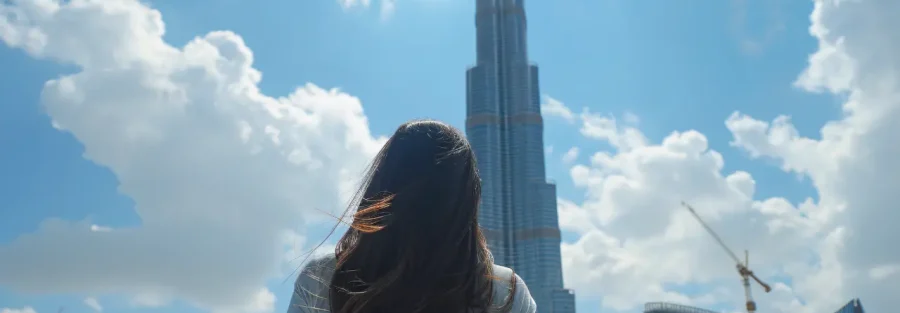
The moment you think about tall buildings, one city almost always comes to mind: Dubai. It has built an identity that is closely tied to height, ambition, and design that pushes limits.
From the middle of the desert, Dubai has grown into a global city known for its skyline. It is not just about having tall buildings. It is about what those buildings represent. Progress, ambition, and the idea that even bold dreams can take shape in steel and glass.
And right at the center of that skyline stands the most famous structure of all.
The Burj Khalifa and Its Global Fame
There is no way to talk about Dubai without mentioning the Burj Khalifa.
It is more than just a building. It is a symbol that instantly connects Dubai with the idea of “the tallest in the world.” When people see it, they don’t just see height. They see engineering on a scale that feels almost unreal.
The Burj Khalifa has become one of those rare landmarks that defines a city globally. Just like the Eiffel Tower represents Paris, the Burj Khalifa represents Dubai in the modern world.
But what is often missed in casual conversations is that its story does not end at construction. In many ways, that was just the beginning.
Beyond Construction: The Challenge of Maintenance
Building something like the Burj Khalifa is one challenge. Maintaining it is another story entirely.
When a structure reaches over 800 meters into the sky, everything becomes more complex. Cleaning the glass, managing the exterior, ensuring safety systems work at every level—these are not simple tasks. They require planning, technology, and constant effort.
For example, cleaning the entire exterior of the Burj Khalifa takes months. Teams work in carefully planned cycles, using advanced equipment just to reach certain sections. The building is exposed to strong winds at different heights, which adds another layer of difficulty.
This ongoing maintenance is not just about appearance. It is about preserving value. A building like this is not only an architectural achievement, but also a long-term investment for the city.
Why Dubai Builds So High
Dubai’s skyline is not accidental. It reflects a larger vision.
The city has positioned itself as a hub for tourism, business, and global attention. Tall buildings help shape that identity. They create landmarks that people remember, photograph, and talk about.
But there is also a practical side. High-rise developments allow efficient use of space in a growing urban environment. As Dubai expanded, vertical construction became a natural direction.
Still, what makes Dubai different is not just height. It is consistency. The city does not stop at one landmark. It continues to evolve its skyline with each generation of projects.
More Than Just Buildings
What makes Dubai’s skyline interesting is how it affects perception. When people see it, they associate the city with ambition and scale.
Visitors often describe the experience of standing in Dubai as overwhelming in a positive way. The buildings are not just structures in the background. They become part of the experience of being in the city.
The Burj Khalifa plays a big role in that. It acts as an anchor point for the entire skyline, reminding everyone that this is a place that aims high—literally and figuratively.
Closing Thoughts
Dubai’s story is not only about tall buildings. It is about what those buildings represent over time. The Burj Khalifa stands as the clearest example of that vision, not just because of its height, but because of everything required to sustain it.
From construction to maintenance, from tourism to global identity, it continues to shape how the world sees the city.
And when you think of skylines that define modern ambition, Dubai is almost always at the top of that list.