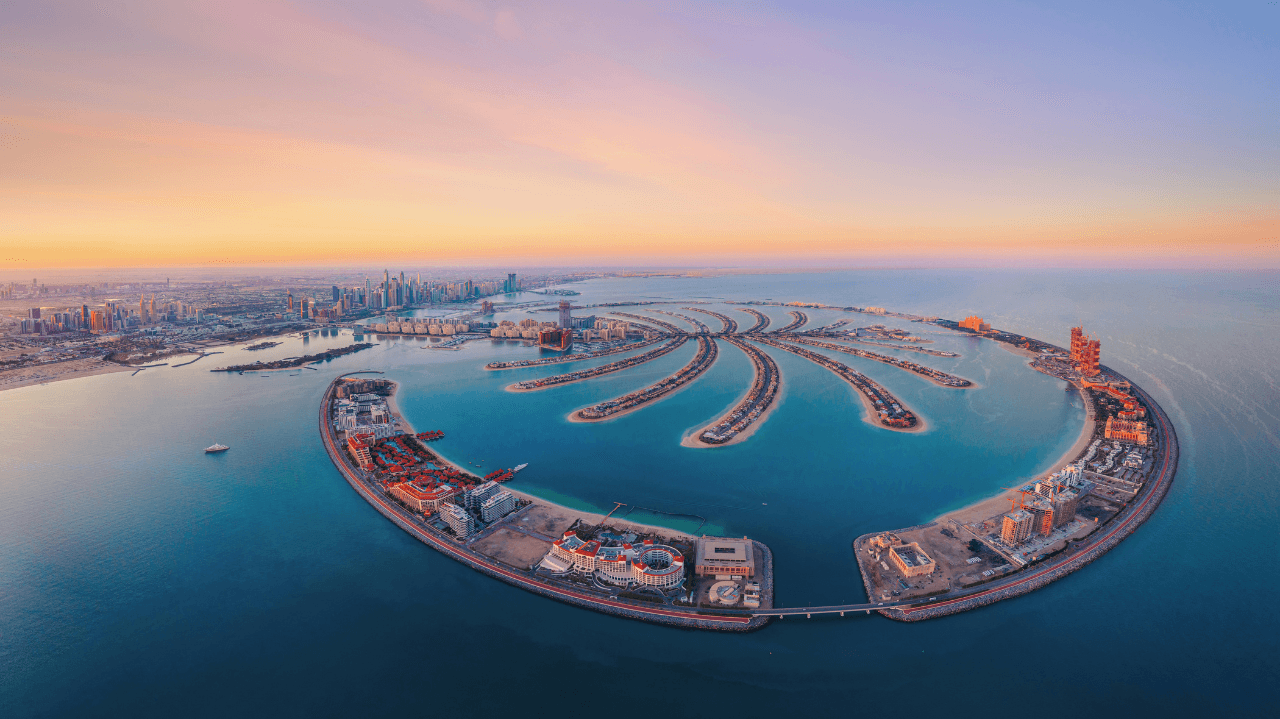
Three hundred man-made islands shaped like a map of Earth sit off the Jumeirah coast. Most of them are still bare sand. This is the story of the strangest empty space in real estate.
If you take a boat about four kilometres off Jumeirah Beach, you will arrive at the edge of the world. Literally. Spread across the water in front of you, roughly nine kilometres wide, is a map of planet Earth drawn in sand: three hundred artificial islands arranged into continents, each one named after a country. There is a Lebanon. There is a Sweden. There is a Great Britain, which Richard Branson once visited with a red telephone box in tow for a photo op. And for most of the past two decades, nearly all of it has been empty.
Not metaphorically empty. Actually empty. Bare sand, gentle waves, the odd seabird, and the Dubai skyline shimmering in the distance like a city that has briefly forgotten it owns an entire planet.
How to build a world
The World was unveiled in 2003 by Sheikh Mohammed bin Rashid Al Maktoum, at the peak of Dubai's anything-is-possible era, with Nakheel, the developer behind the Palm Jumeirah, in charge of construction. The engineering was biblical. Around 321 million cubic metres of sand were dredged up from the seabed and sprayed into the shape of nations, then wrapped in a breakwater of roughly 34 million tonnes of rock stretching about 27 kilometres around the whole archipelago. The project created some 232 kilometres of new shoreline, about three times the length of Dubai's natural coastline, at an estimated cost of AED 50 billion, around 14 billion US dollars.
The sales pitch was irresistible: own a country. Invitations went out to the global elite under the banner of owning the world, with islands priced between 15 and 50 million dollars, and it worked. By January 2008, around 60 percent of the islands had been sold, and Nakheel would later claim the figure reached roughly 70 percent. Michael Schumacher was famously gifted one in 2006. If you were rich in the 2000s and did not at least enquire about buying Finland, were you even trying?
Then the tide came in
Here is where the timing becomes almost cinematic. The final rock of the breakwater was laid in January 2008. Owners were handed access to their islands in September 2008. The global financial crisis detonated one month later, and Dubai's property market fell off a cliff. Funding evaporated, buyers vanished or went bankrupt, and construction stopped before it ever really started. The world's most ambitious address became the world's most expensive sandbank.
It got stranger. In 2010, Penguin Marine, the company contracted to ferry people and supplies around the islands, claimed in a legal dispute that the archipelago was eroding back into the sea, and photographs taken from the International Space Station were widely reported as showing the islands beginning to fade. For a glorious moment, headlines around the planet announced that the world was sinking, which is the kind of sentence you only get to write once. Nakheel denied it, insisted its surveys showed no meaningful change, and won the case. The World stayed above water. It just stayed empty, too. For years, the only sign of life was Lebanon, the single island completed before the music stopped, which reopened in 2012 as a beach club where day-trippers could sip something cold and gaze at 299 uninhabited neighbours.
The world, slowly turning again
And yet, write the whole thing off and you will miss the more interesting ending currently being built. Even now, industry estimates suggest only about 10 to 15 percent of the islands are developed or under active construction. But that slice is getting genuinely busy. The Anantara World Islands resort has opened. The flagship revival is The Heart of Europe, a cluster of six themed islands by the Kleindienst Group featuring floating seahorse villas with underwater bedrooms, with partial handovers underway since 2023 and the developer targeting completion around 2027. The newest addition is a three billion dirham complex including the region's first Buddha-Bar Hotel, floating villas and a dedicated honeymoon island, aimed squarely at European travellers and Gulf staycationers.
In other words, the world is not dead. It was simply twenty years early, waiting for the city behind it to grow into the idea.
What an empty planet teaches
There is a quieter lesson bobbing between those islands, and it applies to far more than mega-projects. Vision and execution are different businesses. Dubai proved it could build a world in five years; filling one turned out to be a twenty-five-year project involving a financial crisis, a court case about sinking, and a long, patient wait for demand to catch up with imagination. The engineers finished on schedule. Reality did not.
For anyone building anything, a company, a product, a market entry, The World is the most photogenic reminder on Earth that being able to build something and being ready to sustain it are separated by a stretch of open water. Dubai, to its credit, never pretended otherwise. It kept the lights on at one beach club, defended the sand in court, and waited. Now the cranes are back, the villas float, and somewhere out there, a country-shaped island with your name on it is still technically for sale. The world, as ever in Dubai, is negotiable.