
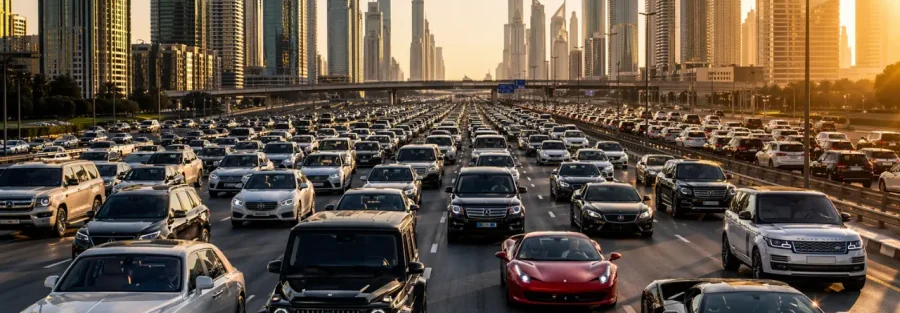
Dubai has 4.3 million cars and 3.8 million people. The roads were never going to win. Every morning at 7am, Sheikh Zayed Road becomes the most expensive parking lot in the world, and 91 percent of the city sits in it, frustrated, late, and somehow still surprised. This is not a crisis. This is just Tuesday. Dubai makes Rush Hour movie feel like a documentation. Speaking of which…
Rolling – More Cars Than People
The arithmetic of Dubai’s traffic is not complicated. It is simply uncomfortable. The city has 3.8 million residents and 4.3 million registered vehicles. That ratio, more cars than people, is not a metaphor. It is the measurement of a city that decided, for twenty years, that the correct response to growth was to add lanes. Registered vehicles grew 8.7 percent year on year in 2024. The roads did not grow 8.7 percent. The gap between those two figures is called rush hour, and in Dubai, rush hour is not an event. It is a condition. It begins at 7am, recedes briefly at 10am, reconvenes at 4pm, and does not fully end. It simply pauses overnight, gathering itself, preparing for the morning.
Slowing Down, On Camera
Peak speed during morning commutes dropped from 35 miles per hour in 2019 to 29 miles per hour in 2025. Six fewer miles per hour across six years. At this rate of deceleration, a Dubai commuter in 2031 will be moving at approximately the speed of an aggressive cyclist. The cyclist will be in an air-conditioned pod. The pod will also be in traffic.
The Last Mile
The last mile speed into downtown during the morning was 21 miles per hour in 2025. Twenty-one miles per hour is slower than a recreational runner and slower than a bicycle. It is, technically, faster than walking, which is the only comfort available to the 91 percent of Dubai residents who experience this daily and describe themselves, in surveys, as frustrated, stressed, or anxious as a direct result.
Cut To – The Metro Nobody Got On
Dubai has a metro. It is excellent. In 2025, 294.7 million people used it. The metro is clean, punctual, air-conditioned, and cheaper than parking. Total public transport ridership hit 802 million in 2025 across all modes. These are remarkable numbers for a city of four million people.
The Paradox Nobody Filmed
The share of journeys using public transport increased from six percent in 2006 to 21.6 percent in 2024. This is genuine, measurable progress. It also means 78.4 percent of journeys are still made by private car. Dubai’s public transport system has grown enormously while car dependency has grown alongside it, at approximately the same pace, in the same city, apparently without either project informing the other of its plans.
For every person who steps onto the metro, two more appear on Sheikh Zayed Road in a new SUV. The SUV is very large. There are now 3.5 million vehicles on Dubai’s roads during the daytime.
Plot Twist – Dh175 Billion. Already Spent.
Dubai has invested Dh175 billion in transport infrastructure over the past twenty years: the metro, 25,000 lane-kilometres of roads, 1,050 bridges and tunnels, 177 pedestrian crossings. A McKinsey study found these investments reduced fuel and time costs by Dh319 billion. The return is real and documented.
Dh170 Billion More. Coming Soon.
In November 2025, the UAE announced a further Dh170 billion package of road and transport projects to be completed by 2030. Federal roads will expand from 19 to 33 lanes in each direction. Etihad Road gains six lanes. A fourth national highway spanning 120 kilometres with 12 lanes is under study. Alongside this: flexible working hours and remote work policies estimated to reduce peak congestion by 30 percent.
Two Answers, One Problem
Both announcements came in the same month. Both are entirely sincere. The Dh170 billion highway plan and the work-from-home policy represent, simultaneously, the two possible answers to the same question. More road, or fewer cars on it at the same time. Dubai is trying both. It is the correct instinct. The traffic has not yet decided which answer it prefers.
End Credits
Dubai’s rush hour is not mockery. The traffic is the direct consequence of success. A city that grew by 378,000 people since 2021, that added 8.7 percent more vehicles in a single year, that attracted the kind of economic growth that fills roads faster than roads can be built, is not failing. It is winning at a pace its infrastructure is working hard to match.
The real question is not whether Dubai can build more roads. It can, and will, and is. The question is whether a city approaching five million people by 2040, with 78.4 percent of all journeys still by private car, can make public transport the preferred choice before the sequel outruns the original. Somewhere on Sheikh Zayed Road right now, four lanes deep in the morning sun, a driver is calculating whether leaving fifteen minutes earlier tomorrow will make any difference. It will not. But the calculation is very human, the traffic is very much still there, and the film, as always, is still rolling.