Not long ago, a grey sky over the United Arab Emirates was a reason to stop and stare. Rain was a novelty, a dusty, fleeting drizzle that cooled the air just long enough to spot a windshield before the desert sun took over again. But over the past two years, the region’s climate narrative has drastically shifted.
Those rare, celebrated showers have been eclipsed by sprawling thunderclouds, torrential downpours, and flooded highways that bring modern cities to a standstill. What was once a quirky meteorological anomaly has rapidly evolved into a dominant national conversation, turning the weather from a brief photo opportunity into a regular, humbling disruption to daily life.
A Year’s Rain in a Day
In March 2026, parts of Abu Dhabi and Ajman recorded almost an entire year’s worth of rain in just 24 hours, shattering typical weather patterns in the arid UAE. Some areas tallied more than 90 milli meters, close to the country’s annual average of about 100 milli meters, leading to widespread chaos. Roads quickly turned into raging rivers, ancient wadis overflowed their banks, and schools, offices, and even malls shut down as emergency services scrambled to manage the unprecedented floods and rescue stranded residents.
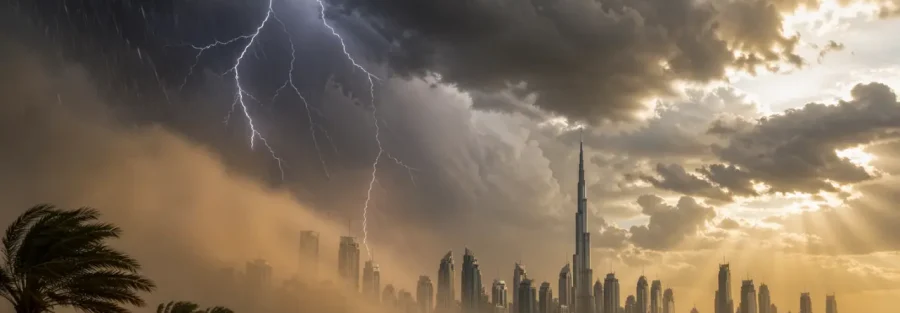
The deluge didn’t end there. A “final wave” of stormy weather swept across the Emirates just days later, delivering even more heavy rain, hailstones the size of golf balls, and booming thunder that echoed through the night. Authorities issued urgent warnings, urging delivery riders to stay off the slick roads, companies to prioritize worker safety by allowing remote work, and worshippers to pray at home instead of risking travel to mosques amid the downpours.
Life and Work at a Standstill
These storms don’t just drench the streets; they upend the entire rhythm of daily life across the UAE. Corporates swiftly shift to remote work, with offices emptying out as employees huddle at home to avoid the deluge; construction sites grind to a complete halt, leaving cranes swaying idly in the wind and workers sheltering under tarps; and logistics networks falter dramatically, as delivery trucks navigate flooded highways or sit idle, delaying everything from groceries to e-commerce shipments. For residents, commuting turns into a gruelling exercise in patience and improvisation, road closures multiply like dominoes, diversions snake through backstreets, and entire neighbourhoods feel temporarily isolated, cut off from the bustling pulse of the city.
Yet, amid the swirling chaos and rising waters, there’s a palpable sense of resilience that shines through. Civil defence teams coordinate tirelessly around the clock, deploying pumps, boats, and heavy machinery to clear roadways and evacuate those in low-lying areas; community spirit kicks in as neighbours check on the elderly and share supplies. Forward-thinking infrastructure upgrades, like Dubai’s ambitious Dh30 billion Tasreef drainage project with its vast network of tunnels and smart sensors, are designed to transform these desert metropolises into flood-resilient powerhouses capable of handling biblical rains. But the stark question lingers, demanding answers: why is a desert nation, long defined by its scorching sands and relentless sun, now facing such persistent and intensifying downpours year after year?
Climate Change: The Desert’s New Challenge
Scientists have long cautioned that global warming extends far beyond rising thermometer readings, it supercharges extreme weather events, turning rare deluges into more frequent nightmares. A detailed study from Khalifa University reveals a troubling trend: stormy days across the UAE have surged by as many as two additional events per year since the turn of the millennium, with each one packing greater fury through fiercer winds, bigger hail, and torrential downpours that overwhelm urban defences.
At the heart of this shift lies a fundamental physics principle: warmer air acts like a sponge, capable of holding vastly more moisture, up to 7% more for every degree Celsius of warming, which then unleashes as intensified thunderstorms and biblical rainfalls when conditions align.
A Region Redefining Its Climate
The UAE’s relationship with rain is undergoing a profound transformation. What was once a rare, celebratory spectacle, brief showers that locals chased with joy under umbrellas turned inside out is fast evolving into a recurring, formidable pattern etched into the calendar. The government’s response has been swift and strategic: hyper-accurate early-warning systems powered by satellite data and AI deliver real-time alerts via apps and mosques; public safety advisories flood social media with tips on sandbagging homes and avoiding wadis; and massive infrastructure projects, from Dubai’s sprawling drainage mega tunnels to Sharjah’s elevated coastal barriers, signal a nation aggressively adapting to these new climatic realities.
For many residents, these soaking spectacles have ignited deeper reflection and a shift in mindset. Emiratis reminisce about parched summers interrupted by miraculous monsoons, while expatriates from rainy homelands swap tales of Dubai’s “cloudbursts” over coffee; families now pack emergency kits alongside iftar spreads, and schoolkids learn flood safety drills as routinely as Arabic lessons. They’re all grappling with a striking paradox: a desert nation engineered for endless sun, now wrestling with biblical floods that turn highways into rivers. It’s no longer a question of whether the rain will come thundering down, it’s about whether this resilient powerhouse is primed, innovative, and united to meet it head-on every time.
Conclusion
Clearly, The UAE’s skies are rewriting the rules. As storms grow stronger and more frequent, the balance between progress and preparedness becomes crucial because in today’s climate, even the desert is learning to swim.